Google+ Positive Psychologist: New Literature

Leader

Showing posts with label New Literature. Show all posts

Wednesday, September 8, 2021

Monday Blues: Explore, dream, discover

Toda, explore, try and discover.

Twenty years from now you will be more disappointed by the things that you didn’t do than by the ones you did do, so throw off the bowlines, sail away from safe harbor, catch the trade winds in your sails. Explore, Dream, Discover.

–Mark Twain


All pics displayed here can be downloaded and used for free. Just give a link here. You can find more pics here: t3i photography.


Sunday, January 17, 2016

Book Review: Alphabet Soup for Lovers - Anita Nair

Not everyone loves a chilly morning in a wet countryside with laziness clinging to your side. You don't want to shake it off as the warm comforter refuses to let go. But then you need something that puts you out of this pleasant misery. A good cup of hot tea can do the trick but a hot soup is my favorite. A hot steaming soup that slowly crawls into your mouth greeting your lips, lighting up your palate, clearing your windpipe and literally waking you up is the one we love. Alphabet Soup for Lovers by Anita Nair one such wake up call for all our settled lives. 

Set in a picturesque backdrop of a tea estate around a majestic house built in British architecture and lots of openness that lets you explore, implore and gives you the space to relax, think, evaluate. For hosts you have the young accomplished lawyer - KK, his wife Lena who finds it interesting to follow her own pursuits in decorating, teaching, taking care of kids at the crèche and finds peace in her routine walks. Everything is wet, warm, damp, cozy and comfortable in its own way. 

In comes the superstar who wants a break from his exciting routine that came to irritate him and finds this place offers him exactly that. At least that is what he was expecting. What happens next is what you need find out in the novella. Set to the theme of food and following what seems to be a trail of alphabetic order, the story presents you chaos in a warm tea cup. Many a time we choose to ignore what is there for us and take things for granted. This story narrated by the elderly, all observing Komathi who is fierce, motherly yet handles her role of the self-appointed caretaker well.


The story is narrated in quick matter of fact way but with the right ingredients of love, passion, beauty and what nature can do to you if you allow it to play with your emotions. Something as morbid as a cemetery can turn into a cauldron of inhibitions and enormous possibilities. The fallen angel in a calm cemetery speaks volumes of the state we are in sometimes. Some dishes are to be relished when hot and can be tacky when they get cold, old and forgotten. The story of Komathi and Rayar is one such tale of a spicy beginning yet calm eternity while Lena chooses to add tadka to her life in her own terms. 

While this can be called another love story, Anita chooses to add spice to an exciting Malabar sojourn in a sweet way. The reader is left guessing for his own interpretations of the story and characters and where they would end up. The flow is smooth and creamy while the protagonists choose to stand out with their own textures adding character to this hot bowl of soup. At the end you are left refreshed but wanting for more. Say hello to possibilities and second chances.

Pick it up today from here.

Saturday, October 10, 2015

Book Review: Punjabi Thali

Things change after marriage. Any change is good but usually the change is met with resistance. Some people fight it and lose. Some people welcome and win. I had a friend called Shalini. She got married about four years ago and went out of touch. It was a love + arranged marriage and we all went to the wedding. Soon after the wedding we lost contact though we were on facebook and stuff. I heard she was doing great from other friends but she rarely met us at any of the social gatherings. 

Recently I met her at a mall and we got to catch up and over coffee the chatterbox that she is, she told me everything that happened over the last four years. We had so much fun. I loved meeting her. I always wondered if this bubbly chatterbox, Shalini would get tamed at her in-laws or would they get bugged by her. But she surprised me. She fit right into the Punjabi family and won their hearts with her sincerity and love. 


Now I am not talking about my friend Shalini but the protagonist in Swati Gulati's book - Punjabi Thali! Yes, Swati manages to build a character so interesting and lucid that she wins over your love and makes space in your close friends list. Shalini is married to in to a Punjabi home and has to cope with the pressures of a joint family and a well oiled machine like life where the diktat of elders is final and any change is questioned. It doesn't end there. 


What actually troubles her is that her all caring, loving husband is neutral to the fights that happen at home and rarely ventures to defend her. Her mother-in-law is a lovable mom but turns all her anxieties amplified towards the new claimant to the house. In this situation how does Shalini cope up with the Punjabi Thali and understand all the nuances of life is what ensues in the book.

Though the book sounds like a long complaint, it actually is readable with the pleasant narrative used by Shalini with ample doses of humour and anecdotes woven in. This book is the story of every woman married in to another family and how she matures to be the Bhabhi or Wife. This transformation happens to everyone in the family and is very pleasant if you want it to be. Unfortunately very few put in the effort to make the journey happy. Shalini's in-laws are much better to be frank and Shalini is smart in her ways too. 


So why should you buy the book and read it? Buy it to see how you can make your journey from a girlfriend to a wife fun, buy to know why you should take up the cause and not the sides, buy to see how you can fall in love with a family, just like in the movies. This book is fun, joyous and true in its core, a tad bit direct. A plate full of sweet, sour, hot, spicy, chunky and fun just like its name.

Buy Punjabi Thali here on flipkart.

Monday, September 21, 2015

Book review: The Fall of Shuruppak

Are you someone who likes fantasy books and appreciate a technical writer who uses his creative writing skills to recreate history? Are you someone who loves academic writing and non-fiction books that makes novels look like a mirror of a civilization readable? 

Well then you must love Dr. Shankar Kashyap. I was asked to review his latest book - The Fall of Shuruppak. In this book he brings to life the ancient kingdoms of Harappa with a finesse of a surgeon with the chaos of the magic from the ancient civilizations as if he has been there really traveling with the protagonist hero and his small group of truth seekers who take up this adventurous journey through the ravishing jungles, fighting ferocious creatures, long sojourns in treacherous rivers, storms and shipwrecks.


What makes you buy this book is the impressive storyline that will grip you and keep you inspired to read more. The interesting, awe inspiring well planned cities of ancient India thump your pride as the doctor uses his years of research to paint a very realistic picture for your reading pleasure. When the lovable protagonist Upaas, a doctor himself, is accompanied by his wife Lopa and the crown prince and the fearless soldier Parthava narrates the story to you, you just sit there and listen.


The interesting turn of events take them in search of various sages while they encounter extraordinary people, scientific discoveries, new lands, threats, fire fights, abductions, miraculous and close encounters while being street smart and move on to the next location.


If this book were a movie, you wouldn’t have anything less than the Lord of The Rings scale. Unfortunately we don’t have many books celebrating the great civilisations of Harappa and Mohenjedaro around Indus Valley with their advanced technology, know-how and what not! When I came across Shankar’s book, this was pure joy.


The epic battle between a mythical creature demon and Enkidu and the great loyalty and friendship between Emperor Gilgamesh and his journey to seek a solution helps us understand the great cultures and values of the Sumerian civilization and their practice of medicine, cultures, religions, how they treated their people, visitors and guests, their economy and what not. The Fall of Shuruppak is less of a fantasy book and more a journey of self-discovery and bonding while educating us about one of the greatest civilizations of the world.


For more book reviews check out this link.

Rating: 3.5/5
Verdict: Pick it up just for celebrating our ancient culture

Thursday, June 11, 2015

Book Review: Elijah... Among the Shades of Time

I am a literature student. I know it is tough to write. Especially if the story is a known one. Known one for about 4000 years. From one of the most famous books. Take one of the most famous battles of epic proportions and try and breathe words into the scenes. How do you do that? How do you attempt something so ginormous and yet come out a winner.  You don't write it. It comes to you. One page at a time. Once scene to another. You live it. It is a rare experience and Susy could make it happen. I am talking about the latest book from Susy Matthew - Elijah: Among the Shades of Time.


Taking a story right out of the historical chronicles in The Bible, Queen Jezebel and Elijah fight it out in their quest to prove the supremacy of the God they believe in and how they turn the favour of the people, Susy does an amazing job handling various complicated characters. This is a rare topic as you would have now imagined and is for the serious reader who likes the heavy stuff and actually enjoys his history and literature. But Susy makes it easy for you. Adds a bit of love, romance and explores the hard facts as they are and could have been. This makes the story easy on your mind when you venture in to it. Though the obvious love story lures you to believe that this is just another book, it actually helps you soak in the seriousness of the times and how futile several of the adventures were. After all those were the times of the mighty kings and the subjects. How Elijah, one of the most powerful prophets in the Old Testament, turns from a reluctant follower to a formidable hero and leader and helps bring in the Lord - Yahweh's will is the crux of the story.


The book is a fast read and paces the story well so that you are in sync with the timelines and are kept engaged to understand what is happening around you. The kind of dread that Queen Jezebel's actions bring up in you is superb. With her command on the intricate details about the levels of the demonic world and the futility of being in the illusion of command is handled quite well. For those of you who like to understand the power of bodily aura, projections and enjoy a thrill in seeking the pleasures beyond the visual, obvious, this book is a delight as it serves you quite a handful. The war in the physical world is just a reflection and a minor representation of the war in heavens but that doesn't make it any less interesting. While I am tempted to reveal the main plot, I don't want to take away your joy in reading and let the story unfold. Despite all the historical significance, a dash of the world of witchcraft, demonic control of the dark world, secretive mystic sisterhood of Baal, a theme of love and a raging war, Elijah promises a racy tale of the fight between good and evil, a story of intricate supernatural manifestation that is served in a small book you can't resist.

A welcome approach to bring out the usually ignored and untouched stories from the ancient books. Susy Matthew does ample justice in representing the landscapes of ancient Israel, culture, relationships, values, family ties and much more. Pick it up today from flipkart by clicking here.

Rating: 3/5

Pic is from here.


Friday, October 10, 2014

Blame nobody

Don't wait for approval. Ask forgiveness, not permission.

Make mistakes. Don't quit. Get it done.

Grind. Grind some more. Ship on time.

Own it when it goes wrong. Thank your team when it goes right.

Easy peasy.

Thursday, October 2, 2014

Book Review: Chetan Bhagat's Half Girlfriend and why you will read it

When you burn your tongue with the first sip of hot double shot coffee, you tend to feel the singe of one too familiar after taste. While this would remain for a couple of days, you would be munching tasteless food while your brain doesn’t understand what you are eating and once in a while you should check your plate to see if it is really the same as what your eyes see. You feel bad but you neither skip coffee nor stop munching food.

When you pick up a Chetan Bhagat novel, you expect to have something new, something amazing and some interesting plot that would keep you mesmerized, teases you, tickles you and engages you in a philosophical dialogue and motivates you in such a tremendous way that you are inspired! Wait! That is not Chetan Bhagat I was talking about. You know what you can expect from a Chetan Bhagat novel. Now that you have removed the sugar coating, you can dust off the last few particles of genius-like-fruitiness; expect what you can get when the title is - 'Half Girlfriend.'

Like I agreed we don't skip coffee or stop munching, Chetan's works are like a second bowl of popcorn. You know you have had enough but are not easily going to skip them. I pre-ordered 'Half Girlfriend', paid 37 bucks more and got it yesterday. Here is the review.

Plot: Take a bit of Three Mistakes, problems mentioned in Satyameva Jayate, imagine a non-English type village boy (like what Arjun Kapoor desperately tries to enact) who is a state level basketball player??? coming to Delhi with small iron trunk to join St. Stephen's. Meet Riya, a rich girl who hates her money-clogged-parents-home and is looking for an escape to a real-rural-self-proclaimed-admiration for poor life where she wants to make fame on her own! Madhav hates poverty and wants to be rich. Riya wants to live a normal life with her own name and dignity. As the book specifies, Madhav and Riya don't want the same thing. Madhav wants Riya to love him. She is confused. Riya is okay being a half-girlfriend. Hugs okay, kisses okay, cuddling okay. Nothing more okay?

Madhav tries to make out with her but she sticks to her half-girlfriend theory. He cusses her and she walks out of the relationship. He gets a 50k/month salary from HSBC in 2007 because he is honest! (No I didn't see this in 3 idiots. Trust me it is a new plot. I have tears in my eyes. Someone pass me a tissue). He doesn't take it and goes back to being the rural poor prince he is to take care of his school for his mom and spends time teaching poor kids. A noble cause stolen from the Satyameva Jayate, TaareZameen Par like twist and is rewarded when he gets a chance to get some funds from Bill Gates and succeeds.

Enter Riya back from her small but personal honeymoon-wedding-divorce while Madhav is trying to learn English in a private coaching class and Riya tries to teach him English and succeeds. A good story would end here. But Chetan wants a story after the interval too. So Enter Madhav's mom who chides her to get out of her son's life. Riya runs away and how Madhav recovers his life, wins lakhs of rupees in funds from Bill Gates foundation and travels to USA (too many Telugu/Tamil movies have shown this already) to find the love of his life. If you stay back till the end, you will find hope in a New York bar with live music.

Wait! Don't you like the story? Want some suspense? Let us make the hero run for the last 10 minutes of the film and put a song, a slow but romantic dark melody that ensures you have tears in your eyes while the hero's shoes hurt, feet splinter and blood oozes from the shoes and he reaches just in the nick of the moment. Now get out of here. You have had enough for the 150 bucks you paid for this film. What?!!! I haven't added a love making scene. Ya. They make love in about 20 words. No space you see!

While I know Chetan would have already pictured Kriti Sanon in the film and would have decided how to make her look taller than she is, he must be counting 300 crores he would get for the film deal. Wait! I think the book would have made him a 100 crore too.

To be concise: The book is fat, Chetan. I would have loved to read some 50 pages less and could do away with the preachy tone in some places. I liked it but as a... how do I say it... forget it, I liked it.

If there is a positive note I have to write about the book, it shows how village grown Madhavs can make out and win over the richest girls and win over anything in their life if they just don't give up. Yes. Don't give up yet! The second one is bringing back basketball to Indian cinema. When did Kajol lose to Sharukh last?

Will I pick up the next book from Chetan? Did you give up on coffee?

Rating: 1.5/5


Wednesday, April 23, 2014

Are you raising a spoilt brat?

Found this wonderful article by  and it is a must read.

Here's your parenting guide to instill the right discipline and responsibilities in your child

Picture this: At a supermarket, your 10-year-old demands that you buy him a box of chocolates. When you refuse, he throws a tantrum and since you don't want to create a scene in front of him, you relent and your son goes home happier. Well, surely, most parents must have come across such a situation at least once in their life. However, have you ever thought of the number of times you've given in to your kid's demands? Chances are that it's more than often and you might be raising a spoilt child. Says consulting psychiatrist Dr Pavan Sonar, "From my experience, I do believe that children today are more spoilt than their previous generation. When we see the behaviour of children of this generation, the basic qualities of attentiveness and respect towards elderly, social manners and discipline is absent in most of them. Abiding by the laws set by parents or society are carelessly ignored by kids today."

So, who's at fault?
According to clinical psychologist Saloni Sawnani, blaming the kid and labelling him/her as 'spoilt' is unfair. "It is more parents' faulty upbringing of the kid that leads him/her to be spoilt. The earlier generation of parents was more relaxed and had more time for their kids. However, with most parents working today, they don't spend enough time with their kids, so they make up by giving in to their demands and as a result, the child is spoilt," she says.

Signs your child is spoilt
Does your child behave insensitively to others? Does he or she want his demands met immediately? "Sometimes, a child might be genetically more energetic than the others, which leads to hyperactivity and you might mistakenly label him/her as spoilt. By five years of age, most children are able to communicate their feelings clearly. So, you need verify their behaviour and channel the aggression positively," says Saloni.

According to Dr Sonar, a spoilt brat is not ready to follow family or social etiquette. "The kid frequently demands money or gadgets. He/she has poor emotional control, throws tantrums, whines most of the times, doesn't take 'no' for an answer, misbehaves with peers and argues with parents," he elaborates.

How to deal with it

Don't label:
 "Understand why your child is behaving the way he/she does. Hear him/her out and find solutions. Most importantly, don't complain that your kid is spoilt to your family members or guests, especially not in front of the kid," says Saloni.

Know when to say no: Agreeing and giving in to everything your child says sends out a wrong message. Giving in to the tantrums tells your kid that all he/she has to do is cry and whine to get what he/she wants. When you say 'no' to your kid's demands, he/she knows that everything in life has a value and he/she has to work towards something if they want it badly.

Be consistent: During the initial years, you might pass off your kid's bad behaviour as just being cute but in the long run, it could have an adverse effect on your child. So, be consistent in your discipline methods. Set some rules and ensure that they are followed consistently. For instance, if jumping on a couch is not allowed at your place, stop him/her from doing so when at a friend's place.

Reward for good behaviour: Instead of bribing your kid by saying 'If you do this, you will get this', reward your kid when he/she displays good behaviour. "Affection always helps your kid," says Saloni. Adds Dr Sonar, "Abolish bad behaviour by rewarding the desirable ones. Awards should be very small gifts or token points."

Teach manners and values: "Storytelling is a great way to teach morals and values to your kid," says Dr Sonar. Instil values of responsibility, sharing, friendliness and sensitivity towards others in your child through various moral tales. Set a good example in front of your kids when it comes to good manners.

Bond over chores: If your kid is in his/her pre-teens, assign a task every day, whether it is helping you out with the laundry or tidying his/her study table. Teach your child that each member of the family needs to contribute towards taking care of the home and each other.

Set expectations: "Try to understand the reason for your child's behaviour and set certain expectations. Effective communication with the kid is very crucial. Teach them to express their emotions, that is, what and how they are feeling, instead of what they want," says Dr Sonar.

Tuesday, April 1, 2014

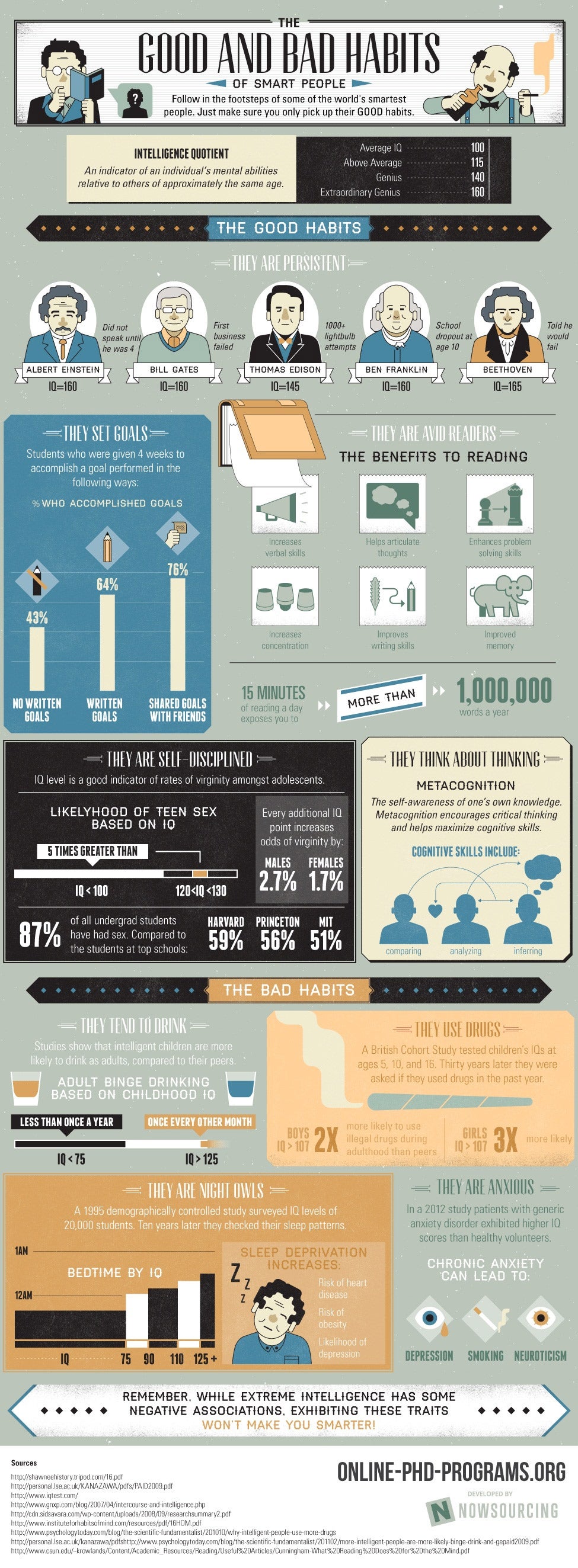
The Habits of the World's Smartest People


Wify forwarded this article by Kathleen Davis to me and it was worth the read. I am sure you would like it too.

 There is no one picture of intelligence, but many people with high IQs do tend to share some of the same habits -- both good and bad. For example, according to research complied by Online-PHD-Programs.org, while those with high IQs tend to set goals and read avidly, they are also more likely to drink more heavily and suffer from anxiety.

 For more on the habits of smart people, including a look at the IQs of icons such as Albert Einstein and Bill Gates, check out the infographic below. Click to Enlarge+


Sunday, January 5, 2014

Is Unselfish Joy Practicable? - Nyanaponika Thera

I bring to you a wonderful article by Nyanaponika Thera who explains how we can find joy in what we do and more importantly why we should avoid in seeking other's failure.

The virtue of mudita [muditaa], [1] i.e., finding joy in the happiness and success of others, has not received sufficient attention either in expositions of Buddhist ethics, or in the meditative development of the four sublime states (brahma-vihara [brahma-vihaara]), of which mudita is one. It was, therefore, thought desirable to compile this little book of essays and texts and to mention in this introduction a few supplementary features of this rather neglected subject.
It has been rightly stated that it is relatively easier for man to feel compassion or friendliness in situations which demand them, than to cherish a spontaneous feeling of shared joy, outside a narrow circle of one's family and friends. It mostly requires a deliberate effort to identify oneself with the joys and successes of others. Yet the capacity of doing so has psychological roots in man's nature which may be even deeper that his compassionate responses. There is firstly the fact that people do like to feel happy (with — or without — good reason) and would prefer it to the shared sadness of compassion. Man's gregarious nature (his "sociability") already gives him some familiarity with shared emotions and shared pleasure, though mostly on a much lower level than that of our present concern. There is also in man (and in some animals) not only an aggressive impulse, but also a natural bent towards mutual aid and co-operative action. Furthermore, there is the fact that happiness is infectious and an unselfish joy can easily grow out of it. Children readily respond by their own smiles and happy mood to smiling faces and happiness around them. Though children can be quite jealous and envious at times, they also can visibly enjoy it when they have made a playmate happy by a little gift and they are then quite pleased with themselves. Let parents and educators wisely encourage this potential in the child. Then this seed will quite naturally grow into a strong plant in the adolescent and the adult, maturing from impulsive and simple manifestations into the sublime state of unselfish joy (mudita-brahmavihara). Thus, here too, the child may become "the father of a man." Such education towards joy with others should, of course, not be given in a dry didactic manner, but chiefly in a practical way by gently making the child observe, appreciate, and enjoy the happiness and success of others, and by trying himself to create a little joy in others. This can be aided by acquainting the child with examples of selfless lives and actions for his joyful admiration of them (and these, of course, should not be limited to Buddhist history). This feature should not be absent in Buddhist youth literature and schoolbooks, throughout all age groups. And this theme should be continued in Buddhist magazines and literature for adults.
Admittedly, the negative impulses in man, like aggression, envy, jealousy, etc., are much more in evidence than his positive tendencies towards communal service, mutual aid, unselfish joy, generous appreciation of the good qualities of his fellow-men, etc. Yet, as all these positive features are definitely found in man (though rarely developed), it is quite realistic to appeal to them, and activate and develop that potential by whatever means we can, in our personal relationships, in education, etc. "If it were impossible to cultivate the Good, I would not tell you to do so," said the Buddha. This is, indeed, a positive, optimistic assurance.
If this potential for unselfish joy is widely and methodically encouraged and developed, starting with the Buddhist child (or, for that matter, with any child) and continued with adults (individuals and Buddhist groups, including the Sangha), the seed of mudita can grow into a strong plant which will blossom forth and find fruition in many other virtues, as a kind of beneficial "chain reaction": magnanimity, tolerance, generosity (of both heart and purse), friendliness, and compassion. When unselfish joy grows, many noxious weeds in the human heart will die a natural death (or will, at least, shrink): jealousy and envy, ill will in various degrees and manifestations, cold-heartedness, miserliness (also in one's concern for others), and so forth. Unselfish joy can, indeed, act as a powerful agent in releasing dormant forces of the Good in the human heart.
We know very well how envy and jealousy (the chief opponents of unselfish joy) can poison a man's character as well as the social relationships on many levels of his life. They can paralyze the productivity of society, on governmental, professional, industrial, and commercial levels. Should not, therefore, all effort be made to cultivate their antidote, that is mudita?
Mudita will also vitalize and ennoble charitable and social work. While compassion (karuna [karu.naa]) is, or should be, the inspiration for it, unselfish joy should be its boon companion. Mudita will prevent compassionate action from being marred by a condescending and patronizing attitude which often repels or hurts the recipient. Also, when active compassion and unselfish joy go together, it will be less likely that works of service turn into dead routine performed indifferently. Indifference, listlessness, boredom (all nuances of the Pali term arati) are said to be the 'distant enemies' of mudita. They can be vanquished by an alliance of compassion and unselfish joy.
In him who gives and helps, the joy he finds in such action will enhance the blessings imparted by these wholesome deeds: unselfishness will become more and more natural to him, and such ethical unselfishness will help him towards a better appreciation and the final realization of the Buddha's central doctrine of No-self (anatta [anattaa]). He will also find it confirmed that he who is joyful in his heart will gain easier the serenity of a concentrated mind. These are, indeed, great blessings which the cultivation of joy with others' happiness can bestow!
Nowadays, moral exhortations fall increasingly on deaf ears, whether they are motivated theologically or otherwise. Preaching morals with an admonishing finger is now widely resented and rejected. This fact worries greatly the churches and educators in the West. But there are ample indications that this may, more or less, happen also in the Buddhist countries of the East where ethics is still taught and preached in the old hortatory style and mostly in a rather stereotype and unimaginative way, with little reference to present-day moral and social problems. Hence modern youth will increasingly feel that such "moralizings" are not their concern. In fact within the frame of the Buddhist teachings which do not rely on the authoritarian commandments of God and church, but on man's innate capacity for self-purification, such conventionalized presentation of ethics which chiefly relies on over-worked scriptural references, must appear quite incongruous and will prove increasingly ineffective for young and old alike. The need for reform in this field is urgent and of vital importance.
It was also with this situation in view, that the preceding observations have stressed the fact that a virtue like unselfish and altruistic joy has its natural roots in the human heart and can be of immediate benefit to the individual and society. In other words, the approach to a modern presentation of Buddhist ethics should be pragmatic and contemporary, enlivened by a genuine and warm-hearted human concern.
In this troubled world of ours, there are plenty of opportunities for thoughts and deeds of compassion; but there seem to be all too few for sharing in others' joy. Hence it is necessary for us to create new opportunities for unselfish joy, by the active practice of loving-kindness(metta [mettaa]) and compassion (karuna), in deeds, words, and meditative thought. Yet, in a world that can never be without disappointments and failures, we must also arm ourselves with the equanimity (upekkha [upekkhaa]) to protect us from discouragement and feelings of frustration, should we encounter difficulties in our efforts to expand the realm of unselfish joy.

Note

1.
Usually rendered by unselfish, sympathetic, or altruistic joy.

Tuesday, December 10, 2013

"Good" Morning!


I love reading www.stanleyonbible.com and this is a beautiful post I couldn't ignore.

Everyday we pass through so many situations where we are lured to show our nasty side (trust me it is there in both you and me) and it hurts both the sender and receiver. Stanley spells out a solution from the Bible.


God does not ignore what we speak when we are agitated with anger and agonizing in anguish. Rather He takes a serious view of it. The Book of Job vividly illustrates this point. What God said at the end of the story is a sober truth. He told Eliphaz, "I am angry with you and with your two friends, for you have not been right in what you SAID about Me, as My servant was" (Job 42:7).

What lies beyond death and grave is the greatest strengthener of our feeble hands and weak knees. We have every reason to be agitated and lose patience in suffering if there is no life after death. How many long hours we sometimes wait in visa issuing offices to travel overseas! How much we rejoice when the visa is finally stamped on our passports! How much more patient should we be today for the glory land we would enter tomorrow! "What we suffer now is nothing compared to the glory God will give us later" (Rom 8:18).

When we lose patience in any situation, virtues leave us one by one, and vices lift up their ugly heads. We suddenly realize that we have spoken detestable words which are too many to be taken back. If we are quiet and confident, we can declare, "God knows the way I take; when He has tried me, I shall come forth as gold" (Job 23:10).

Think of the words of impatience poured out of our mouths while suffering in the past. If God had reciprocated our anger and impatience, would He have delivered us from our problems? Waves are nothing to those who regularly bathe in the sea. Likewise let us get accustomed to live with sufferings. See what Paul has written in Romans 5:3-5: "We can rejoice when we run into problems and trials, for we know that they are good for us—they help us to learn patience. And patience develops strength of character in us, and character strengthens our confident expectation of salvation. And this expectation will not disappoint us!"

The disease of Job was awful. He was dying daily without dying. But he knew that there was light after the tunnel, and life after death. This confidence gave birth to this song: "I know that my Redeemer lives... And after my skin is destroyed, this I know, that in my flesh I shall see God!" (Job 19:25,26). This cannot be anything but the prophetic expectation of the glorified bodies which will be given to the children of God in the New Heaven and New Earth! Cheer up, dear Christian, your night will soon be over and there will be Dayspring!


Monday, October 14, 2013

Monday Blues: Stay patient


Patience is the secret! Doctors need patience to perform successful surgeries. Engineers need patience to build complex structures. Teachers need patience to produce distinguished scholars. Parents need patience to raise responsible children. Scientists need patience to explore shrouded mysteries. Spouses need patience to build harmonious families.

Stay patient as God has a plan. Wait and see what that is while he is working on you.


All pics displayed here can be downloaded and used for free. Just give a link here. You can find more pics here: t3i photography.


Tuesday, August 20, 2013

Think like a leader


Read one of Robin Sharma's best posts till date. Here is an excerpt. Think like what you want to be.

The root cause of all rare-air productive, financial, personal and global success...

...your psychology.

If you're not thinking like the dominant star of your industry, your performance will never rise to match that expectation.

If you're not thinking you can get your massive dreams done, your behavior will never be sufficient to get giant goals done.

If you're not thinking like someone who's the rockstar of their field, financially free, healthy as an athlete and happier than you could ever imagine, then there's no way you'll get there.

Why? Because your outcomes always reflect your self-identity (a.k.a. your psychology).

Researchers like Sonja Lyubomirsky have done some fascinating work on "the power of the self-fulfilling prophecy". Definitely read her book The How of Happiness this week.

Bottom line: the hard-core psychologists confirm that your psychology and expectations for your performance determine your results.

You absolutely have to learn to think like the very best do to experience the rewards and lifestyle that the VERY best have.

Wednesday, August 14, 2013

19 Victim Versus Leader Distinctions

19 Victim Versus Leader Distinctions:
#1. Victims talk about people. Leaders talk about ideas.
#2. Victims procrastinate around their goals. Leaders execute on them.
#3. Victims enjoy watching things (like TV and video games). Leaders like making things.
#4. Victims are distracted. Leaders are concentrated.
#5. Victims abhor change. Leaders Adore change.
#6. Victims read what everyone reads. Leaders read what few do.
#7. Victims associate with other victims. Leaders spend most of their time with superstars (and thereby dramatically elevate their productivity and success).
#8. Victims are stuck in the past. Leaders are inspired by the future.
#9. Victims resist hard projects. Leaders seek them out (knowing it refines their chops).
#10. Victims work at mediocrity. Leaders view work as an opportunity to pursue Mastery.
#11. Victims give most of their time to leisure. Leaders spend a ton of time on their learning.
#12. Victims tear people down (because it makes them feel better). Leaders lift others up.
#13. Victims are rude. Leaders are polite.
#14. Victims practise negativity. Leaders are unreasonably positive.
#15. Victims can’t wait to retire. Leaders are afraid to retire (why retire when you’re having so much fun building something important, growing more leaders and producing value for the world?).
#16. Victims waste time. Leaders exploit time.
#17. Victims achieve things for the applause. Leaders achieve them for the fulfillment.
#18. Victims sleep late. Leaders rise early.
#19. Victims view work as a means to pay the bills. Leaders view work as a way to change the world.

My great wish is that these ideas inspire you to Lead Without a Title, lift your teammates to their next level of wow and grow a great company.

See more at: http://www.robinsharma.com

Wednesday, August 7, 2013

Monkey See Monkey Do

Read a superb article in Bangalore Mirror today!

My daughter and I were at a green traffic light once, when a pedestrian ran across my path (avoiding eye contact, of course), forcing me to step on the brakes in a hurry. Now jay walkers, I was prepared for. I customarily stare them down, hoping to thus hurt them in the brain or something.

What I wasn't prepared for, was hearing my 3-year-old quickly add - “Idiot!”

I turned around, aghast, and she smiled sweetly, as if she’d helped me out. The next 10 minutes were spent in quiet self-examination. Wow! I didn't even know I was judging people aloud. What else was I saying that this sponge was absorbing and replaying in the correct (and possibly - incorrect) context?!
I watched myself from that day on and realized the many things I was doing, including frowning incessantly and saying ‘Okay, hmm’ when I was distracted and not really following her stories.  Mums and dads who act surprised when daughter slams a friend at a party, or uses inappropriate words, here’s the rough guide to the things your child is learning from you; evident or not.
Do YOU keep house rules? Last week, I heard myself tell my toddler – “If you beat your sister, I will whack you. No beating allowed here, ok?” He hit her anyway. In my head, I slapped myself. Outwardly, I added sheepishly, “Only mum is allowed to beat anyone," and walked away before I dug a deeper hole.
Being polite to all people alike? Your son is not going to respect people if he doesn't see you do it – key word – consistently. And when there’s a forced kindness to ‘people who matter’ while you’re trying to belittle the waiter at a restaurant, your little guy will soak in the messed-up system and probably mess up many times before he perfects/decodes your parenting lesson.
Are you lying while they’re listening? I know a little child who lies effortlessly and that had me stumped till I met the dad – a friendly guy who once picked her up late from our house after a play date. He then promptly dialed her tuition teacher from our place and said: “Sorry ma’am, she’s skipping tuition today. We got delayed at a family function.”
Are you talking behind peoples’ backs? Monkey see, monkey do. Been there! One Sunday, my mum sat next to a tireless, talkative nun and told my grandma all about it when we returned home. A few days later, on Commercial Street, I remember yelling out – “Hey ma, there’s the ‘yappy nun’ from church!”
Do they see you as trust-worthy? Kids learn quick, that if you’re talking about someone to them, you’re talking about them to someone. This is a precious finding, especially if you have a tween/teenager at home. Keep your lips locked, mum; or your daughter will shut you out.
Showing mercy on the road? Your child will grow up learning to be tolerant, and that’s a good thing. Obedience to the law of the land will come from imitation, and without the need to be judgmental.  A drive presents endless opportunities to talk about poverty, traffic rules and big life lessons.
Do you listen? Listening to your children will teach patience and give them the feeling of being valued. They will feel loved and know that their voice means something. Being a pushover will never be an option and you will have led by example!
Most of all, keep your word. Sponges have ears. Big brother may not be watching, but little daughter is; and that’s way scarier.

Sunday, October 21, 2012

Book Review: Cut Like Wound

Isn't it textbook for a police officer to solve a case when he is suspended? Isn't it true that children end up doing what you tell them not to do? Isn't it funny that you have all the films of a police officer who is rogue, cares little about the rules, ignores his superiors and has a devoted family or has a problem at home? Isn't it text book to have a villain who is mysterious, powerful and cunning that you cannot find out who he is when he is standing right next to you? Well, take all these regular recipes and try to cook something new or you have an option to create a similar recipe but make it into a pleasing familiar dish that takes you to a nice place.

Anita Nair is a wonderful writer. In fact, hers would be one of my first choices for a weekend with a book, coffee and chips. I love the way she can bring out words and play with emotions easily out of the unknown. Her understanding of the human psyche, especially women psyche, is beautiful. Here in "Cut Like Wound" she comes out with a familiar story without delving in to what she can actually do. "Introducing Borei Gowda" comes as an early warning and sets out the course clear in this story. May be I should have known...

Anita Nair’s Inspector Borei Gowda, “soft in the middle, blurred at the edges” who knocks back shots of Old Monk, lovingly tends to his Bullet, and is blessed with superior deduction skills, that superpower of every hero detective from Poirot to Dalgliesh, is an anomaly in the Bengaluru police force and therefore a perfect protagonist.  Borei Gowda is a middle aged father, husband who fails on both parts, at least on what he feels she should be doing for them and is a old football-you-bought-and-used-for-a week in the police department. Known for his keen ability to excel and propel himself into the strongest and unclear situations and is ruthless Dabang attitude, Borei forms what you look for in a middle aged hero contemplating a divorce while wooing his high school sweetheart who is rich but conveniently divorced.

The plot is simple and tight. First a dead body appears of out no where. And sometime later another. Soon there are bodies every Friday night. All of them seem to be linked but there is no common link. Only Borei seems to have a link established between them and chases the ghosts of his own imagination while fighting with the system , authority, drug dealers, a powerful corporator, and himself. I like the way he personifies his bike and draws immense pleasure from simple situations that usually are the solace of a tired lonely soul. Nair's characterization runs with Borei and captures him in many angles and she has done a wonderful job of keeping the story simply attractive and with in a short span of 38 days. The rest of the story is about how Borei and his team finds out the mysterious murders and brings them to justice.

What Anita has managed to do in the book is to explain the realities of the shady areas in any town and how people are so madly driven by the experiences they have in their childhood and every day. "Cut Like Wound" also tries to look at the changing phenomena of the acceptance of transgenders and the reality. I am thrilled with the way she explains the streets of the city in Shivaji Nagar which can be in your city as well and places where you cannot go or are usually advised to keep out. Cut Like Wound takes you there and beyond while keeping the hair on your neck raised, every moment of the way. There is more to come in the next adventure of Borei...

I have an author-signed-copy thanks to flipkart :)

Rating: 2.5/5

Saturday, July 14, 2012

The Taj Conspiracy: Book Review


Long. Really looooooong. That's how I felt when I saw this book and it came as a surprise package. I have to agree this is heady stuff. Coming from a background in history with special interests in architecture, especially Hindu and Mughal aerial topography, I have found this interesting. To put into perspective, this is a combination of history meets crime meets bollywood meets murder meets emotional atyachar meets chemistry meets carbon dating meets snake charmer meets communal riots meets reality of life in India meets unity meets sincerity! But for a change I kind of liked it!

Here is how the story goes. A dead body is discovered by Mehr, a Katrina Kaif styled history loving, Indian origin NRI who comes to India in search of her roots and finds herself entangled into the exploding story of communal riots and how some elements play the cards to fight it out for the Taj Mahal and the Shiva temple in the same structure.

In the process she meets, archaeologists, fanatics, survives several murder attempts, meets police officers, has close encounters with her own ghouls and goes through what we can call a bollywood style chasing sequence with mysteries all around. It is an exciting journey to follow Mehr and try to understand why we need to accept the reality of History and move on with a wider all accepting view. In between you find yourself transported on a lesson in linguistics and calligraphy, to a cave in Kashmir and enter in to the minds of criminal eradicating pest-control mode of policing by Pratap and SSP Raghav who are true in their spirit and passion but have different styles.

Sprinkle in some onion sautéing and old monk fueled revelry and a delirious liking for the dead bodies and how they are treated. You would need to find time and effort to follow the actual plot of declaring Taj as a Shiva temple and different pieces in the puzzle to make sense. How Mehr, aided by her two police friends solves the mystery and comes to a close shaving climax where she is rescued by the hero is very entertaining to read.

I liked the small chapter style and a matter of fact reporting with importance on food, moments that can get missed in a blink, action, in fact well packed action and the depth of knowledge in the author, especially when treating architecture and mystery. This is beautifully handled and woven into the story. Though it can be slightly cut short, may be by 50-60 pages, I think it is ok as long as the reader doesn’t get bored. The book made me go back to my college days where we used to spend hours discussing the differences in the temple architectures and the materials used and what was the reason. 

To summarize, this is folklore + action + local detective + politics served with hot masala chai for you. What is missing is sugar, but isn’t that the way SSP Raghav likes it?

Rating: 3/5

This review is a part of the Book Reviews Program at BlogAdda.com. Participate now to get free books!

Adapt